
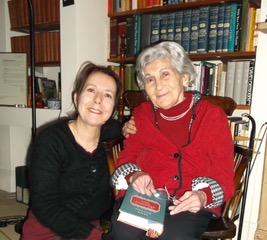
My first thought, before writing this article was – what on earth could I add to the subject that Kató hasn’t already written in her book Stage Fright. Or to quote Yehudi Menuhin on Kató`s book, ”it is the most realistic and practical approach imaginable….this book should be worth its weight in gold to every student and many a performer”.
Nevertheless, the New Approach is kept alive through experiences and people sharing these with others.
Usually, as we all know, childhood experiences are the ones most deeply engraved in us. There are good ones and not so good ones, but they tend to remain with us, and I learned during my studies with Kató that a long solved problem can return because of what she calls ”memory habit”.
Anyhow, Kató starts her book revealing her story as a child prodigy. She vividly describes the excitement of playing her first recital, the pink ribbon in her hair and frilly dress and most important – that she couldn´t wait to play for all those people. Unfortunately things didn´t always stay that way, although she continued to perform with great success. She refused to accept this, she began to have stage fright and this is where a life long journey of discovery, culminating in the New Approach started.
I was not a child prodigy: in fact I started to play at the age of twelve. By the time I was thirteen though, I found myself playing Vivaldi concertos in public.
Like Kato I couldn´t wait to play for all those people (although I had a little physical discomfort even then). The little bit of stage fright I had though turned into a positive excitement, and I also remember dressing up in my lovely red velvet skirt, frilly blouse and shiny white shoes. So far so good.
Aged fifteen I found myself doing an entrance exam at the Vienna Music Academy, but the importance of this event was unknown to me. I was accepted by a very prestigious teacher, a great player but known to drive students hard.
“So who is going to teach me,”I asked innocently after the exam.“You are with me,” came a voice from behind. “And how much are you going to practice?”, he continued, looking into the depths of my eyeballs. I had never practised more than an hour, but felt this probably wouldn’t do. “A lot,” I blurted out, to his great amusement.
It turned out that eight hours was expected of me, which I mostly did, being a dutiful girl. On days of lectures it was about five hours. I left school to be a music student, which I did not mind at all.
There were happy times, many wonderful lessons but also physical aches and pains, combined with the pressure of ”having to play well”. And like many others I was afraid of lessons, as not playing well meant hell breaking loose. Little by little the joy of playing for people had turned into a worry of, ”am I good enough?”, or even worse, ”are others better?” What I did learn though was real commitment.
Later on I changed to study with Professor Thomas Kakuska, a wonderful player and human being and member of the famous Alban Berg Quartet. He sent me to Kató`s summer school, for which I am eternally grateful to him. “It will do you good,” he said. Little did he know I would never return. We kept on excellent terms though.
So I attended Kató`s summer school when I was seventeen and took a year off, which ended up being five years. I was able to go into real depth with the New Approach, and study most of the repertoire from Mendelssohn to Paganini, freeing myself physically and mentally bit by bit. I never had pain again, only on rare occasions due to a heavy orchestra schedule. But by then I knew what to do about it.
The summer school then was combined with a three week festival, an invaluable opportunity to gain experience on stage and experiment with the newly found freedom. My culmination then was a solo concert in a church with the festival orchestra, playing the Viotti violin concerto, marking the end of my studies. My enjoyment of playing for all those people was back. No stage fright! I distinctly remember Kató, at the performance, hiding behind a pillar at the very end of the church and signaling to me how to pulse, sing and open my arms to play out and swing. She remarked later in class that anyone apart from insiders who may have looked back would have thought she was demented. But it did help. It had the desired effect and I got a great write up.
Unfortunately one cannot always have Kató behind a church pillar and meanwhile, I am a performer and New Approach teacher myself. I have also found myself hiding somewhere, making gestures to my pupils-although the occasion might not have been so public.
I also give workshops. These are of course a wonderful opportunity to play for everybody in a non-competitive environment. Kató would always say, “please play badly but give me the music”. Sometimes just this is enough to eliminate the stage fright the player may have had! Like in Kató`s courses, my workshops also have players of very different levels, and everyone is there to find the ease, to give and get more enjoyment out of playing. They are so absorbed in the nature of the work, the concept of good and bad seems not to arise.
Of course it is up to everybody then to decide to what degree they want to go into the workings of the New Approach. Personally, I think to be really free on stage to give the music (unless you are a rare natural), to “become the music”, as Kató says, you need to develop the inner ear and the inner song in order to feel you have no violin and no bow, a strong rhythmic pulse and all channels are open – you need to go deeper and deeper. But this doesn’t happen from one day to another and requires work. Nothing like my eight hours practice in the past, as I described, but a very different kind of work which is enjoyable but can also be quite tiring (mentally).
So far I have indirectly mentioned several causes for stage fright using my own personal experience and those of students. Some of these causes are: the fear of not being good enough: comparing with others: physical aches and pains and memory habits. Every “cure” for these problems you will find outlined in Kató’s book in more detail.
There are of course many other aspects of stage fright, like the fear of memory lapse, which I experienced preparing to perform the long Tchaikovsky violin concerto (I am playing more and more solo these days). I was able to handle it well, using Kató`s advice to divide the music into sections and practice them in order and in reverse order too.
I think it is also importantto playto something when you are practising in preparation for a performance. You avoid listening back to yourself and get yourself geared up for giving and projecting. Listening back to yourself can be another great cause for stage fright.
Of course being a professional player one is confronted with different kinds of pressures than those when being a student. I have been a full time orchestral player and know what it is to be under pressure, not only emotionally and physically (being over tired and traveling a lot – in my case moving a lot) but also financially; just having to win that audition because you need work and often living with financial insecurity. Perfect conditions for stage fright.
Life as a musician can be very hard. At times like this, it is so important to remind yourself why you are doing what you are doing and what a gift it is to be born a musician. You also need to take good care of yourself, eat properly etc.- (Kato recommends an eggnog before playing) You will need energy to perform. You need to cultivate the need and importance to give the music, even if your audience happens to be a jury. You are doing it because you love it. You love your instrument and the sound it makes, you love yourself (most difficult of all), you love the music and last but not least you love your audience.
Caroline Duffner – Punitzer
Caroline Duffner – Punitzer is a professional violinist and teacher living in Vienna. She is KHANA Representative in Austria.
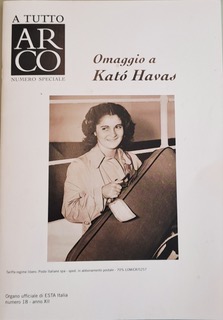
This article has been published in an honourary issue for Kató Havas in “A tutto arco”, the magazine of ESTA Italy, 2019.